
Developers Want City’s OK To Build Big. Here’s How They Sweeten The Deal

On a recent Sunday afternoon, dozens of people stopped by a craft fair hosted by Ala Moana’s newest residential high rise project, the Park on Keʻeaumoku. Kids played with balloon animals. A man gave away free plants. People meandered through the booths and enjoyed the vibes as a man performed mellow songs on the guitar.
Mānoa resident Pam Kuwamura was enjoying visiting the building’s indoor food court, which hosts mostly local restaurants, alongside family visiting from Kauaʻi. While she’s skeptical that locals could afford to live in many of Honolulu’s sleek new condominium buildings — the Park’s listings started around $350,000 for a studio — she said she likes the addition to the neighborhood.
“At least they have some green space,” she said.
That green space was the outcome of a trade between developers and the city. The developer got to build almost 1,000 new apartment units between two towers, each 400 feet tall. That’s higher and denser than what the city’s zoning would normally allow. In exchange for the allowances, the Park provided community benefits: more units deemed affordable than the city already requires, money for street safety improvements and a big grassy park along Keʻeaumoku Street with a minimum of six annual events hosted onsite for the public.
These kinds of trades — bending zoning rules in exchange for community perks — happen on the mainland too, and are becoming more common locally as developers plan for increased housing along Honolulu’s planned rail line. Agreements can vary widely depending on the project, causing some residents to scratch their heads over how the benefits are chosen and whether they represent a fair trade between big-money developers and the communities where they seek to build.
On an island that desperately needs more affordable housing for locals, some are wondering whether the county is using its power to the fullest and getting the most community benefit out of these developers.
“It seems very arbitrary to us,” said Dale Vanderbrink, an Ala Moana resident who serves on the neighborhood board.
More projects are on the way. Under a city program that allows developers to build higher and denser in anticipation of Skyline reaching urban Honolulu, the city – which has the leverage of the permitting system – has an opportunity at each location to extract promises of community benefits such as more units of affordable housing and additional public spaces for the neighborhood. The council has so far approved eight projects in Ala Moana and one in Chinatown.
Last month, the Department of Planning and Permitting recommended the City Council approve another deal, this time for a hotel and condominium development known as 1588 Ala Moana that would rise out of the Macy’s parking lot at Ala Moana Center. The city permitting office is proposing that Developer BSC Acquisitions II, an affiliate of Blacksand Capital and the Kobayashi Group, provide millions of dollars in community benefits to improve the streetscape. Blacksand Capital and the Kobayashi Group did not provide responses when asked for comment.
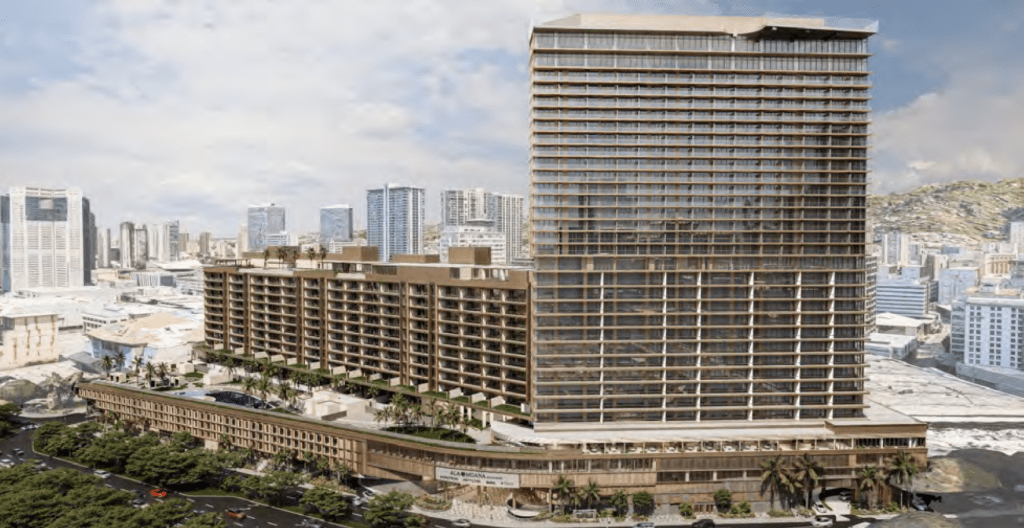
For it to proceed to the next step, the project will need to have a hearing at the City Council, and members of the public will have the opportunity to weigh in at a future council meeting. That could come in September, according to the zoning committee chair council member Esther Kiaʻāina.
More: Why Isn’t Hawaiʻi’s ‘Affordable Housing’ More Affordable?
Desire For More Affordable Housing
As proposed, 1588 Ala Moana’s construction would flout current zoning standards.
Despite being built on land zoned for a maximum height of 100 feet, one of its towers would be 200 feet tall and the other would be 400 feet. It would have more than twice the maximum density allowed by city law. And rather than gradually leaning away from the street the higher it gets, a requirement intended to let natural light reach the street and prevent an urban canyon effect, it would rise relatively straight up.
The rules are negotiable though. City officials’ long term vision is for Ala Moana to be a dense urban neighborhood with a Skyline rail station, and the plan is to rezone the area accordingly.
But completing the required meetings, plans and ordinance changes for rezoning can take years. In the meantime, the city allows developers to apply for permits that mimic the denser standards they envision for the area, and the deal is that developers repay the public by providing community benefits.